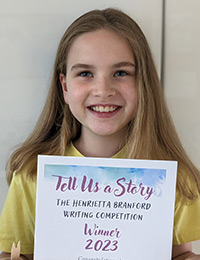
Six talented young writers, winners of Tell Us a Story, the 2023 Henrietta Branford Writing Competition.
Six talented young writers aged between 8 and 18 are the winners of this year’s Henrietta Branford Writing Competition for Young People. The judges have also chosen two more stories to be awarded Highly Commended.
Entrants were asked to write a story on the theme of ‘an unexpected friend’, inspired by last year’s Branford Boase Award winner, Maisie Chan and her book, Danny Chung Does Not Do Maths. The theme clearly caught the imagination of young writers, attracting over 250 entries.
Competition judge, Prue Goodwin says:
‘When we opened the competition, we reminded everyone that this writing was not a piece of schoolwork, it wouldn’t be marked by the judges, just read to be enjoyed as a good story. And we got hundreds of fantastic stories! Exciting ones, funny ones, moving, adventurous, frightening ones – congratulations to our winners and Highly Commended authors, and to everyone who entered. Keep writing!’
 This is a story dealing with environmental issues but, despite the gravity of the topic, written with a pleasing sense of humour and delightful lightness of touch. Sylvie is amazed when she sees a boy wearing a ruff around his neck (as worn by William Shakespeare). Several other children are dressed in unusual items of clothing from Victorian times, the 1940s and the swinging 60s. There is even a teacher in an ABBA jumpsuit. Sylvie observes this school trip very carefully and notices that the children are making notes: ‘Pollution, very bad. Food, very unhealthy.’ What are they doing?
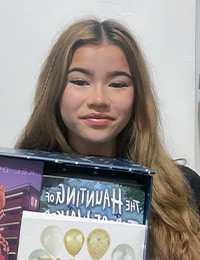 Marie’s story Francis and I is the kind of love story that involves an interesting take on the theme of friendship. Not everyone makes friends easily and some people prefer solitude, yet finding an unexpected companion may trigger positive outcomes. With a mature style and clever use of a first-person narrator, this tale keeps readers wondering how an unusual relationship might develop into a true friendship.
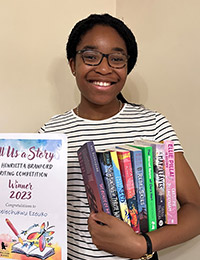 It is clear that this author is very perceptive on the dynamics of friendship. The narrator, Grace, considers the gradual nature of becoming friends and what’s left unsaid between friends, as she questions herself about her uneasy feelings of misplaced loyalty. An effective use of the second-person makes this simple, but very thoughtful piece, a compelling read.
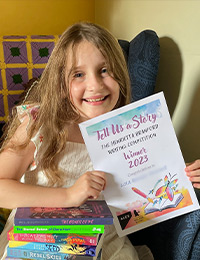 The opening of this story sets a familiar scene for most readers as the experience of being evacuated in the 1940s is the theme of numerous children’s books and part of the current history curriculum. Readers meet George and his little sister saying farewell to their mother as they set out to find safety away from the bombing of Liverpool. The author takes care to be accurate with historical details; there are mentions of rationing, gas masks and general insecurity. However, at the heart of the plot is a subtle reference to social status and the impact of poverty on the chances of city children being welcomed as evacuees. This is not, however, a sad story. There are many touches of humour and an ending which is particularly clever and satisfying.
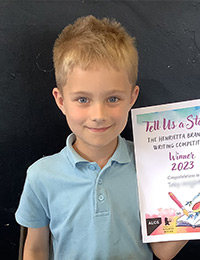 Most primary school teachers know that 8-year-olds can have the most amazing facility to tell or write surreal, and unexpected tales. The Story of the Hamsters is such a tale. However, set out in short chapters, this an intriguing recount of a girl who falls into a lake and finds herself in an alternative world (much like going through a wardrobe or down a rabbit hole). Perhaps it is when readers encounter a large hamster, with a ‘slow voice as deep as an elephant’s’ that they may feel bewildered. A fascinating and enjoyable read; full of originality, fun and surprises.
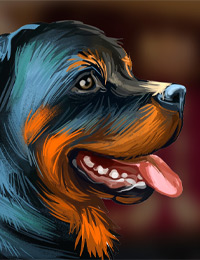 A famous opera singer, Megan Winslett-Carter, wants to adopt a Rottweiler. Her appointment to pick up her new pet involves three feisty women – Megan herself, Connie McNeil, the dog’s current owner and Connie’s ill-mannered mother. Each character is skilfully drawn and, although the trio only meet briefly, their meeting is packed with awkwardness. Readers may feel for each of them but should probably be most concerned about Prizzi, the dog.